

What would happen if we operated without strategy? The answer is simple. Resources would be wasted, decisions would lose direction, and metrics would become the goal rather than the tool. In a world driven by data, dashboards, and artificial intelligence models optimizing in real time, the real risk is not a lack of information. It is a lack of direction. Without strategy, efficiency can increase while value quietly erodes.
Artificial intelligence is exceptional at optimizing simple functions. It improves response times, reduces costs, and automates decisions. Strategy, however, lives in complexity and ambiguity. AI does exactly what we ask it to do. That is where the danger lies. If we optimize the wrong metric, it will do so better than anyone. Technology does not question the purpose. It simply executes. When KPIs replace reflection and speed replaces judgment, the metric itself becomes the purpose.
We have already seen this happen. Algorithms buying homes that later generate massive financial losses. Recruitment systems that replicate human bias. Models that prioritize volume over quality. This is not a data problem. It is a direction problem. The numbers go up, but reality moves in the opposite direction. Decisions are made because the dashboard says so, not because they respond to a clear vision of the business.
Many organizations confuse strategy with planning. Planning organizes known actions within a relatively stable environment. Strategy appears when the environment changes, learns, or responds. It is also not simply an objective. Strategy is not only about what we want to achieve, but about what we consciously decide not to do in order to achieve it. Strategy is focus, coherence, and deliberate trade-offs. It is choosing where to compete and where not to.
In this context, recovering strategy means returning to a set of essential conversations that many organizations have stopped having. The first are conversations about purpose and direction, which clarify why we act in the first place. They are not about efficiency, they are about meaning, because without that clarity optimization becomes blind. The second are conversations about consequences, which force us to examine the side effects of our decisions and consider second and third order impacts. Without them, early success can quietly turn into long term risk. The third are conversations about the environment and the variables we do not control. These discussions define what we are truly observing and move organizations away from opinion and toward evidence. Without this reflection, even data can be misleading. Finally, there are conversations about learning. These allow organizations to adjust without losing their identity, to transform results into learning rather than justification, and to avoid repeating mistakes that have simply been optimized.
When these four conversations about purpose, variables, consequences, and learning come together, strategy stops being a static document and becomes a living practice. It becomes informed intention, strategic responsibility, adaptive improvement, and organizational maturity. As Peter Drucker famously said, efficiency without effectiveness is an elegant form of failure. In the age of artificial intelligence, the real advantage is not optimizing faster. It is optimizing with purpose.
In the era of AI, this becomes even more critical. Without a clear definition of purpose, value proposition, and differentiation, automation can amplify mistakes instead of advantages. Technology accelerates. Strategy provides direction. When both are aligned, growth becomes sustainable. When they are not, the result is efficiency without meaning.
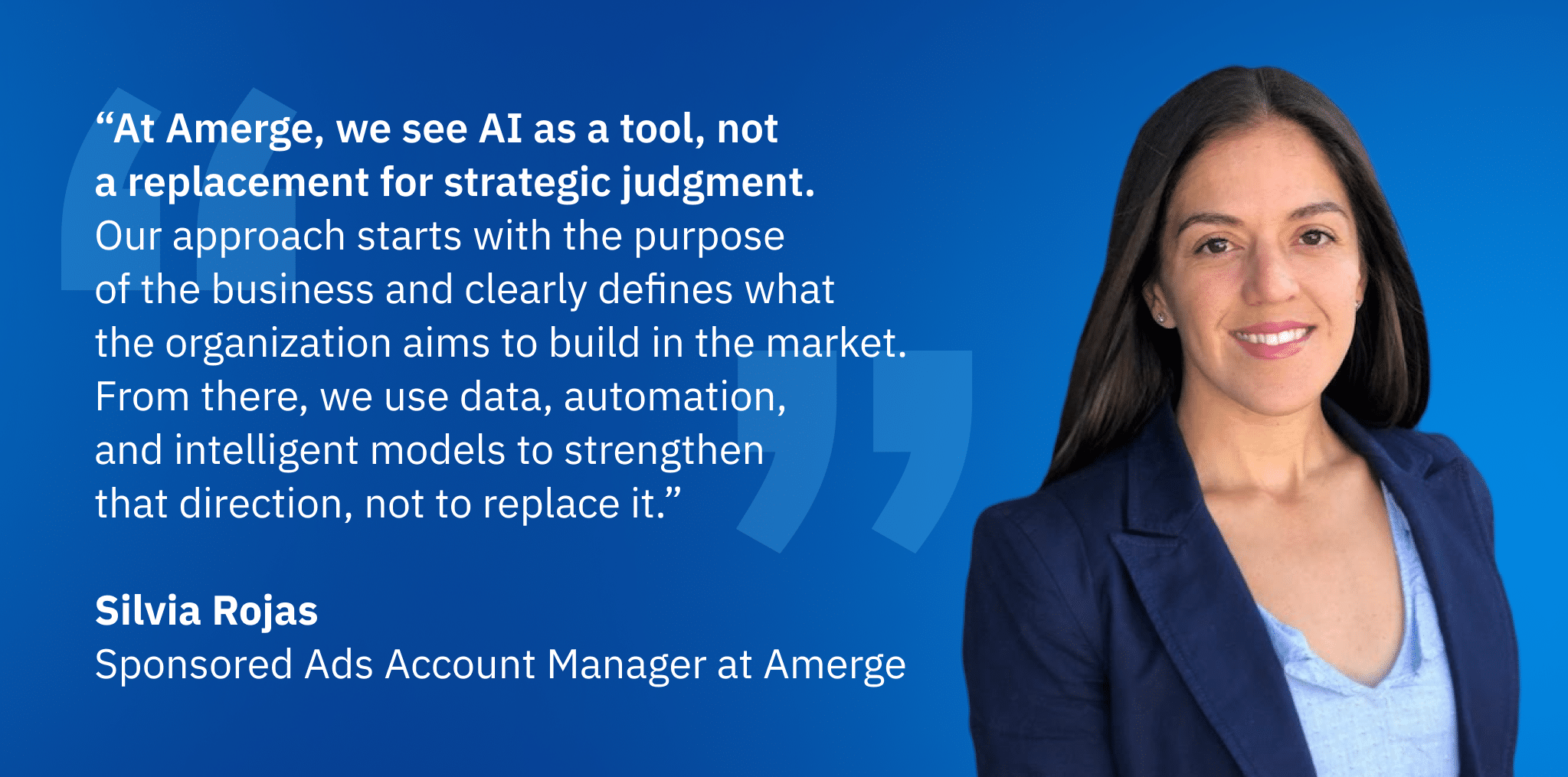
At Amerge, we see AI as a tool, not a replacement for strategic judgment. Our approach starts with the purpose of the business and clearly defines what the organization aims to build in the market. From there, we use data, automation, and intelligent models to strengthen that direction, not to replace it.
In my experience managing Sponsored Ads accounts, this balance between technology and strategy becomes very real in day to day work. As an Account Manager, I use AI driven tools such as Amerge Engine to automate bid adjustments, targeting, and campaign optimization. At the same time, Amerge View allows me to analyze performance from a broader perspective through advanced reporting and data visualization. The real difference, however, does not come from the tool itself. It comes from how the information it generates is interpreted. AI can identify patterns, detect opportunities for efficiency, and accelerate optimization. Strategic thinking is what determines which metrics truly matter, which signals deserve attention, and how those insights connect to a client’s business goals. In that balance between automation and strategic judgment, artificial intelligence stops being only a driver of efficiency and becomes a genuine engine for growth.
If you want technology to work in service of your strategy rather than the other way around, let’s talk. Because without strategy, artificial intelligence can be powerful. With strategy, it can be transformative.