
Brand Defense is the practice of bidding on your own branded keywords (e.g., your brand name, specific product names, or product variations) within Amazon Sponsored Ads. The goal is simple: dominate the search engine results page for your own name so competitors can’t steal your traffic.
The goal isn’t necessarily to discover new customers – it’s about protecting your high-intent traffic. You are buying insurance on the digital real estate that already belongs to you. If you don’t bid on your own name, your competitors absolutely will, placing their products at the absolute top of your search results page.
Why the Beauty Segment is Highly Vulnerable: The Trap of the “Semi-Planned” Purchase
While brand defense matters across all of Amazon, the beauty category operates under a unique consumer dynamic that leaves undefended brands highly exposed to competitor encroachment.
Data published by Amazon Ads indicates that a staggering 45% of Amazon beauty purchases are “semi-planned.” This means that while a consumer opens Amazon with an active intent to buy a beauty product – and often has a specific brand in mind – they have not fully committed to the exact final item, shade, or variation.
Because nearly half of the shoppers looking at your brand are still actively open to suggestion, your branded keywords are a high-stakes battlefield. If a competitor bids aggressively on your name and captures the top-of-search placement, they are intercepting a consumer who is psychologically primed to look around.
Without a defensive PPC shield to anchor your own traffic, you leave your semi-planned buyers exposed to immediate defection. A competitor’s high-production video or product ad can effortlessly disrupt their path, shifting their focus from your product to theirs at the exact moment they are standing at the finish line with their credit cards out.
Strategy: The Incrementality Balance
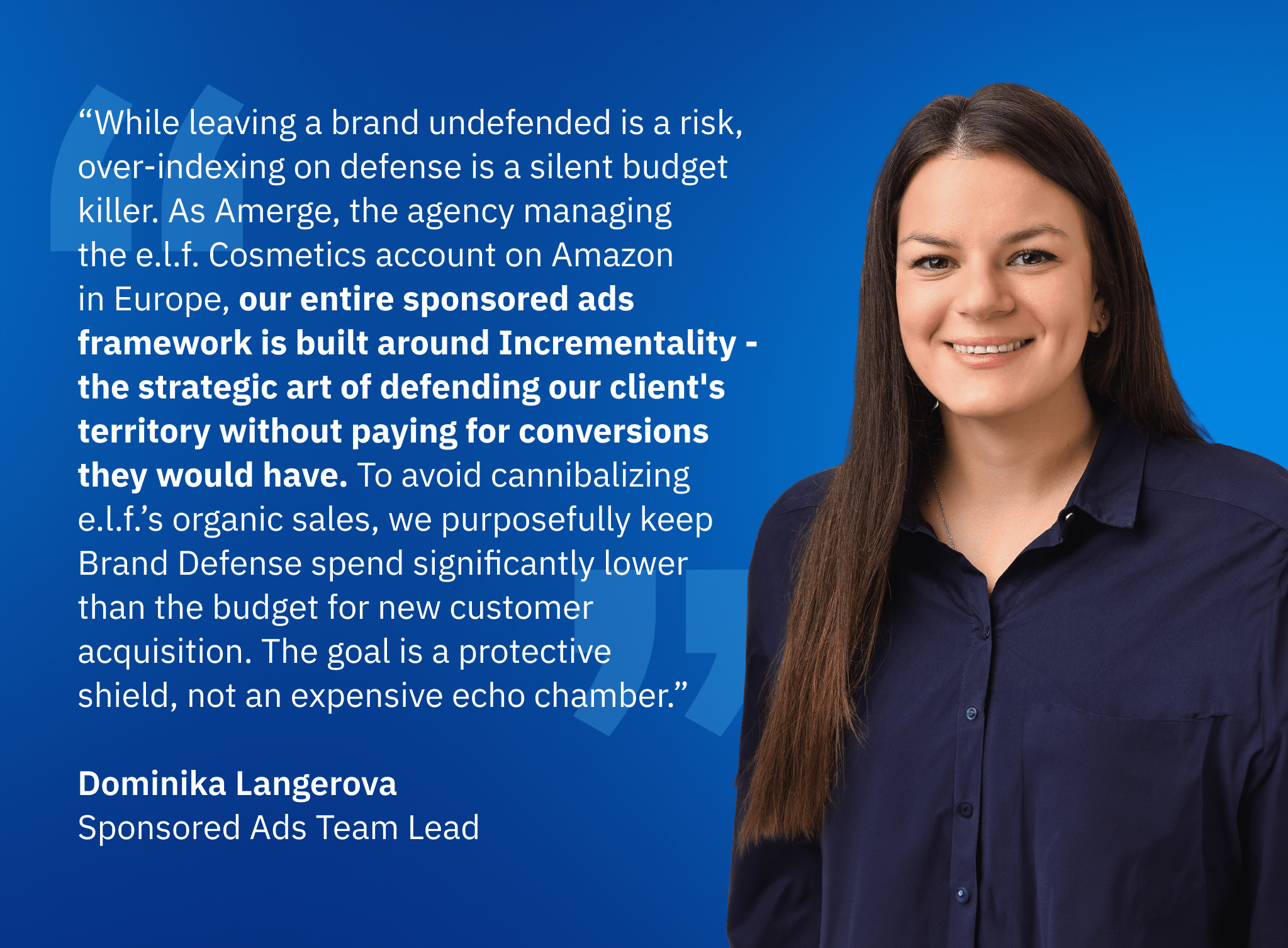
While leaving a brand undefended is a risk, over-indexing on defense is a silent budget killer. As Amerge, the agency managing the e.l.f. Cosmetics account on Amazon in Europe, our entire sponsored ads framework is built around Incrementality – the strategic art of defending our client’s territory without paying for conversions they would have. To avoid cannibalizing e.l.f.’s organic sales, we purposefully keep Brand Defense spend significantly lower than the budget for new customer acquisition. The goal is a protective shield, not an expensive echo chamber. – Dominika Langerova, Sponsored Ads Team Lead
To prove whether our Brand Defense is actually driving new revenue or just stealing from e.l.f.’s organic sales, we look past misleading metrics like ROAS. Instead, we focus on two simple indicators:
- The Ad-to-Organic Split: This is our primary check for cannibalization. If we increase our brand defense spend and the percentage of ad-driven sales goes up while total revenue stays completely flat, we are not driving growth. We are simply paying Amazon to buy back traffic that e.l.f. would have captured organically for free.
- TROAS: Instead of looking at isolated ad reports, we track Total ROAS, which combines both paid and organic performance. This metric ensures the entire business ecosystem is growing and prevents highly efficient, cheap brand defense conversions from artificially masking bleeding inefficiencies in our aggressive customer acquisition campaigns.
The most effective brand defense strategies protect market share while creating room for growth. Contact Amerge to discuss how your brand can balance protection, profitability, and incremental performance on Amazon.